





Kuan Pujan
State: Haryana
District: State Level (every District implements this activity)
Good Practice: Kuan Pujan
Objective: To reverse son-centric rituals and promote gender equality
Key Stakeholders: District Administration, Anganwadi Workers, Anganwadi Supervisors, CDPOs, Parents, Panchayat Members, Community Members
Activity Duration: 2-3 hours
Frequency of Activity: Approximately 15 times a month
Target Group: Community Members and Parents of Girls
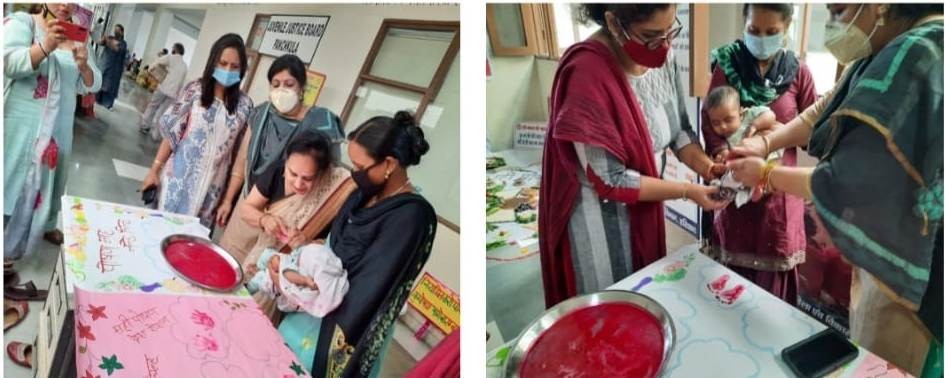
Description of Practice: The mother’s side of the family puts together gifts for the new born girl. On the day of the ceremony, the mother puts water in a matka and goes to a well or temple where a ceremony is conducted. There is a procession and a ladies’ sangeet that accompanies her to celebrate the arrival of her daughter. Food and sweets are distributed at the end of the ceremony. In villages that have a low Sex Ratio at Birth, the District Administration encourages families to conduct this activity. Anganwadi Workers help identify families within villages and encourage them to conduct this activity.
Status of Practice (Pilot/Scaled Up): This activity has been scaled up across the State. Initially, this activity was implemented in a few villages in which Red Cross was active. The local Red Cross office used to initially give families that conduct a Kuan Pujan for girls financial benefits.
Factors behind Success of Practice: The role of the AWW is crucial in identifying families who can conduct the ceremony.
Challenges in Implementation: The community’s mindset is challenging to change because this ritual is traditionally son-centric. In particular, the elderly folk in the villages are rigid in their views, given the deep-rooted nature of patriarchal norms. Often, even neighbours of families with new born daughters need to be persuaded to accept Kuan Pujan for girls and requires acceptance for participation at the community level.
Awareness Generation Resources: Mother’s meetings, Balika Manch, Anganwadi Worker visits and Panchayat meetings
Quantitative Outcome/Value: 100-150 Kuan Pujans have been conducted per year for the last 5 years in 21 Districts.
Qualitative Outcome/Value: The acceptance of daughters as family members who are no longer considered a burden has increased. The community is willing to celebrate their birth. Today, under the implementation of BBBP, this activity is being conducted without financial benefits (that red Cross used to be involved with) as a mass movement. The community has learnt to implement it in order to accept daughters and girls as their own. There are instances in which the District Administration has been asked for financial benefits to conduct this ceremony. However, there is a change in the mindset of most people in the community regarding this event, which is why the scale of this activity has increased across the State.
Existing Documentation/Implementation in Other Locations/Future Prospects/Potential for Impact: This activity can be linked with plantation drives and the putting up of name plates of daughters in homes that have daughters. Conducting Kuan Pujan on a large scale for girls born in the village by celebrating the birth of many girls at one go would help reduce the financial burden of implementing this ceremony at the household level. A Village level programme would help generate greater acceptance of girls and parents of daughters.